

Synergy and Timing In The Delivery

One of the most complex aspects of creating efficient movement patterns in athletes is that we are chasing a moving target in a lot of ways. There are certainly principles that underlie clean patterns that show up across the best in the world but there’s also a ton of variation in how those patterns are achieved (Not to mention small variations pitch to pitch).
One of the more prominent ways this shows up is in how the body times up with itself, this is a concept that we often like to call synergy. If we think about the delivery as music, synergy is essentially the mix. Are all the vocals and instruments aligned in a way that work together with the right timing so that you hardly notice them as individual parts?
This is where things can often become difficult as a coach, each athlete is a dynamic system with unmeasurable pieces that work together. The human body has 11 major organ systems, 206 bones, over 600 muscles, and 12 fascial lines. Not to mention a mind and a nervous system that has pre-existing coordinative strategies for all that material that is different based on previous experiences, injury history, and changes day to day. With all of this, how can we as a coach look at an athlete’s throw on video once and say with certainty how their body needs to organize and what constraints they need to get there?
The simple answer is we can’t, but we can get better at trial and error by understanding the human body a bit better, understanding the human themselves in front of us, and understanding the underlying patterns of the best in the world.
When looking at the body there are a number of things that will interact to affect the timing of individual parts in the delivery and how they coordinate with others. Some of the main players are the fascial system, the athlete’s ability to create relative motion, and the nervous system.
Main Player #1 - The Fascial System
For the fascial system, an athlete’s pre-existing amount of length and stability across fascial lines already make certain movements a bit bigger or smaller naturally, as you could imagine, this in turn affects the timing of all other parts. Fascial lines are used most efficiently when their elastic properties are able to deliver energy. For this to happen, slack needs to be pulled out across these lines. In simple terms, the pulling out of slack is getting those fascial lines to their length (or stretch) so that they either rebound well to create force or stabilize well to act as an anchor while another portion of the body rebounds to create force.
For example, something that is seen in a lot of high level throwers is that they are able to pull slack out in the middle of their body by the time the front foot anchors to the ground, allowing the arm to be delivered with the trunk. In a reductionist sense, this is basically whether the athlete gets the spiral line to length as the front leg anchors to the ground (there are actually multiple lines interacting here). Some athletes present with a ton of length fascially, and as a result they require bigger movements to pull that length out. These bigger movements can look different from athlete to athlete, but the common denominator is that the moves will likely require more time and for other parts of the body to stay connected during this time, or at least disconnect in a way where they can reconnect on time.


Look at the differences in length we see cross body between George Kirby and Serathony Dominguez. These are two of the best arms on the planet and one has a lot of slack to pull out in the middle of his body and the other has very little. Having more slack to pull out means that the body must find a strategy to create time to pull that slack out. Each person’s body is different and may find a solution to this in a number of different ways. Those resulting movements could happen fast or slow, but regardless when more slack is available it means there is more space that needs to be moved into in order to find stability within the system.
Main Player # 2: Relative Motion
The fascial system is also at all times interacting with other connective tissues, muscles, and bones. So oftentimes the abilities of these other structures make the stretch and release of these fascial lines more or less difficult.
To understand this interplay, an important concept is relative motion. In anatomy class, we are taught about how to classify movements in terms of extension/flexion, abduction/adduction, and internal/external rotation. When we refer to relative motion, though we are referring to body parts movements relative to other body parts. For example, if I stand normally and then I turn my hips to the left, my left hip would be internally rotated relative to my left femur.
Our body’s ability to execute technical movements (such as the throw) is largely impacted by our ability to find relative motion. These small structure-on-structure rotations are what allow us to seamlessly shift and leverage different parts of our body (fascia, muscles, and other connective tissue) to accomplish the task in front of us as efficiently as possible.
Another way to clarify this concept is to think of it the way physical therapist Bill Hartman describes it, everything that happens in the body is either expansion or compression. Every movement we make, our body is either creating space or closing space relative to itself. Closing space would be internal rotation, any two joints or structures are getting closer to each other (Compression), and creating space would be external rotation as two joints or structures get farther from each other (Expansion). These motions don’t happen in isolation and as one area expands or compresses the whole system responds as the body works to maintain tension and integrity at all times.


(Examples of expansion across spiral line and extension of t-spine while front leg begins to compress)


(Examples of IR & Compression of the upper body while the back leg maintains length into release)
Before we bring this back to the throw, understand that physiologically what’s happening when an area expands is that it is accepting force and that when it is compressing it is producing force.
The throw is ultimately a symphony of both of these things and certain parts of the body could be expanding while another is compressing and vice versa. The timing and sequence of this expansion and compression is what ultimately leads to efficiency of movement, that is the ability to create the most with the least amount of effort. The space structurally that an athlete must close to create force in an area also affects timing in this way. You can visualize this when looking at the arm spiral into release. Pitchers with more aggressive layback would have a longer transition into internal rotation and ball release while pitchers with less layback would have less space to close. Space the body has to cover doesn’t always equate to time, depending on the athlete’s physical makeup, but it is a consideration when trying to solve the puzzle of how an athlete’s body can best synchronize its movements to work together.
Main Player #3: The Nervous System
When it comes to performing a skill, the nervous system is the underlying driver for learning. Your nervous system is your brain's communication network with your body and it has some control over almost everything. So, when you step on the mound your nervous system is in many ways dictating how you will throw based on your previous training, current physical state/ intensity, and the goal at hand.
The other thing your nervous system controls is rate of force development. How quickly you can apply force is dictated by the nervous system both in a general sense (motor unit recruitment & rate coding), but also in a specific sense (synchronization).
Meaning the nervous system plays a role not only in how fast you can produce force but also in how much force you can produce with coordination within a task. Ultimately, your brain will not let you produce so much force that you can not achieve the task you have set out to perform. It will naturally dial back force production in order to execute.
This is where the value of moving well on the mound shows up, it allows you to express more of your force production abilities. When it comes to timing specifically in the delivery, you can simplify the role of the CNS this way. How fast or slow you can create force impacts the movement strategies available to you. The nervous system will also naturally map movement options off pre-existing structural and physical constraints.
Looking at Timing in the Delivery
In the hitting world, the idea of timing is popular for good reason. With some of the best hitting minds stressing the idea of starting early and putting yourself in good positions to react and be adjustable to each pitch that comes in. Pitching in its essence is no different other than having the ability to set the pace yourself. This is unfortunately where so many movement strategies fail. The athlete can end up giving themselves too much time or too little time.
Often when the pace is set too slow, parts of the body can work independently. There is no time constraint forcing them to work within tight windows and so as a result they can get to too much length and become disconnected. They are stuck creating gaps they are too slow to close.
The inverse is also true, when pace is set aggressively fast the body can have a hard time pulling out slack (w/o Pre-tension). Essentially if the body can’t stretch to its length then it can be hard to find a consistent way to repeat similar movement patterns as you aren’t able to leverage physical constraints to guide the pattern.

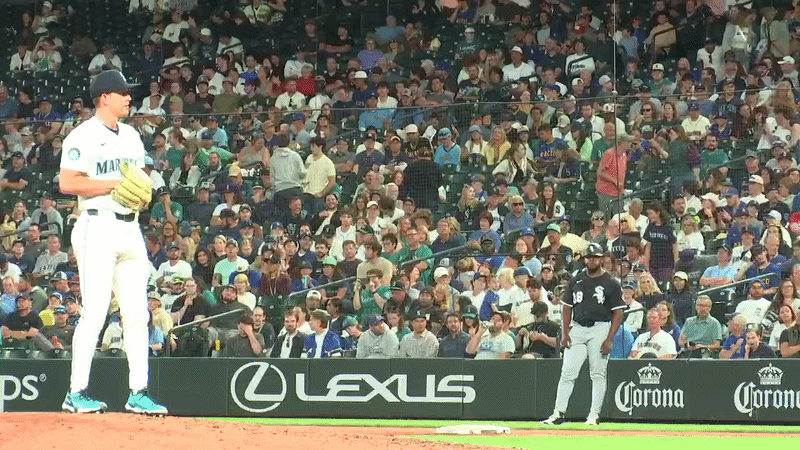
(Example of differences in initial pace/tempo)
Practical Examples
So, if we simplify the delivery down to the idea of creating gaps and closing gaps, then from a timing standpoint, all we are looking for is that the gaps are created and closed at the right time and in the right places. For brevity sake, we will roll through just a few examples of this, starting with a couple fascial lines.
Let’s look at the spiral lines, into front foot strike as we mentioned we are looking for slack to be pulled out across the body. When this happens we also like to see the opposite line work reciprocally. Meaning that as a right-handed pitcher, the spiral line going from your left hip to right shoulder is being stretched as the line from your left shoulder to your right hip is fighting to keep itself compressed.

When the timing of this move is off we often see the torso leak early. Ultimately, if we want that spiral line to rebound out of end range and give us free energy then we need somewhere to send that energy. When the stretch across that line is found too early the athlete is sometimes unable to hold it until the front foot is in the ground (early torso rotation) and then on the inverse, if that spiral line is stretched too late then it’s likely not reaching its full length. That inability to get to length may contribute to a lack of output or consistency.
The body is a complex organism and while we talk about one part of the body specifically, like the spiral line, we must understand how many other things are occurring. During that time into front foot strike you also have a fascial lateral and frontal lines that may or may not be at length contributing to some slack being in the system, multiple relative motions occurring to within the body that affect the pulling out of such slack, and a physiological hardware that may or may not be able to stabilize itself within that certain timeframe available to it.
So let’s look at our same example through a different lens. Into front foot strike we want to see an athlete anchor the front foot with the spiral line at length. The length of the athlete fascially affects how this looks but so do some other physical characteristics. For example, how the athlete is able to shape change the ribcage, how long it takes them to apply internal rotation on the back leg, and how long it takes them to get the front foot anchored.
This is where relative motion plays a role in what that timing of movement is going to look like as well. For simplicity's sake let's just look at the lead leg. Some athletes will present with more internal rotation on the lead leg leading to a longer amount of time needed to get to their “end range”. This can be artificially manipulated with stride direction for example as an athlete with a lot of room in the lead hip can stride closed to make it quicker for them to get to their end range and vice versa. The foot’s orientation also plays a role here as in most cases more supinated feet are going to be able to accept force faster on that lead leg than the contrary.


Takeaways
We’ve just looked at a couple examples of how timing in the delivery is affected by physical characteristics and abilities. In a complex system like the body we likely need to be less particular with the type of positions we are trying to get athletes into and become more entrenched with helping our athletes organize into patterns of movement that are well timed relative to what their physical constraints are. Instead of analyzing movement through the lens of mechanical checklists, what if we start asking better questions? Questions like what could the body be buying time for with this odd or disconnected movement? Or, What parts of the body need more time to keep up? Or even, What are some strategies this athlete could use to create more time or take it away based on their body?
Looking at the delivery in this more holistic and abstract way could certainly be exhausting, but it may be this process that allows us to simplify things for the athlete as we hold less tightly to commonly held beliefs on pitching mechanics and allow more room for self organizing machines to move towards the best version of their delivery.


Comments